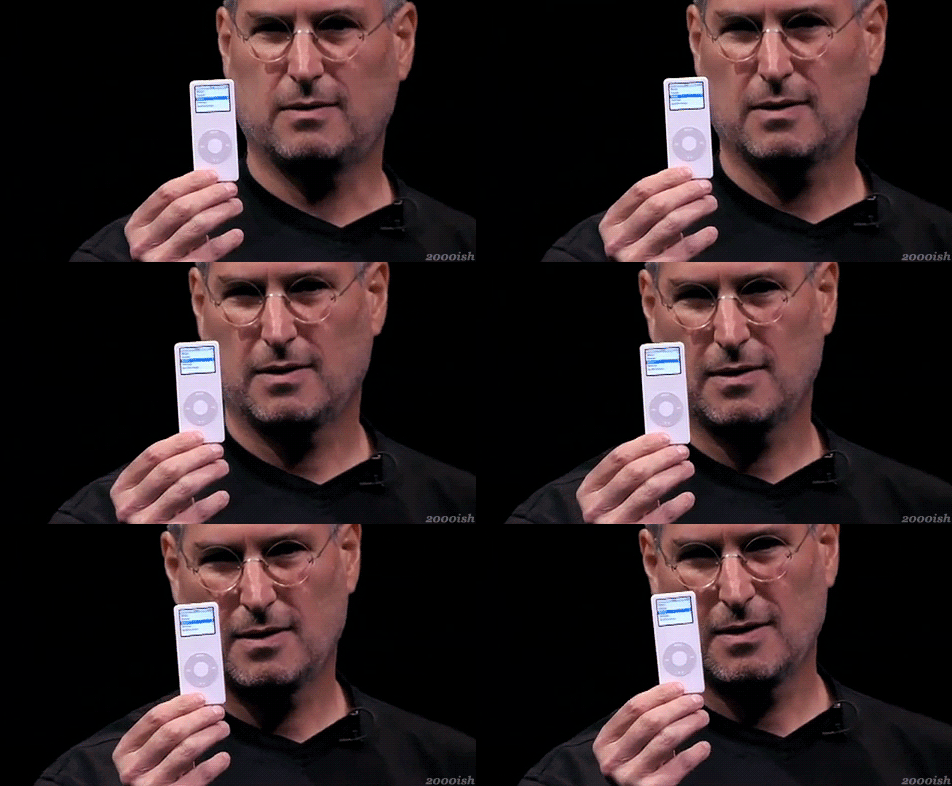
Audio-
The third-generation iPod had a weak bass response, as shown in audio tests. The combination of the undersized DC-blocking capacitors and the typical low-impedance of most consumer headphones form a high-pass filter, which attenuates the low-frequency bass output. Similar capacitors were used in the fourth-generation iPods. The problem is reduced when using high-impedance headphones and is completely masked when driving high-impedance (line level) loads, such as an external headphone amplifier. The first-generation iPod Shuffle uses a dual-transistor output stage, rather than a single capacitor-coupled output, and does not exhibit reduced bass response for any load.
For all iPods released in 2006 and earlier, some equalizer (EQ) sound settings would distort the bass sound far too easily, even on undemanding songs. This would happen for EQ settings like R&B, Rock, Acoustic, and Bass Booster, because the equalizer amplified the digital audio level beyond the software's limit, causing distortion (clipping) on bass instruments.
From the fifth-generation iPod on, Apple introduced a user-configurable volume limit in response to concerns about hearing loss. Users report that in the sixth-generation iPod, the maximum volume output level is limited to 100 dB in EU markets. Apple previously had to remove iPods from shelves in France for exceeding this legal limit.
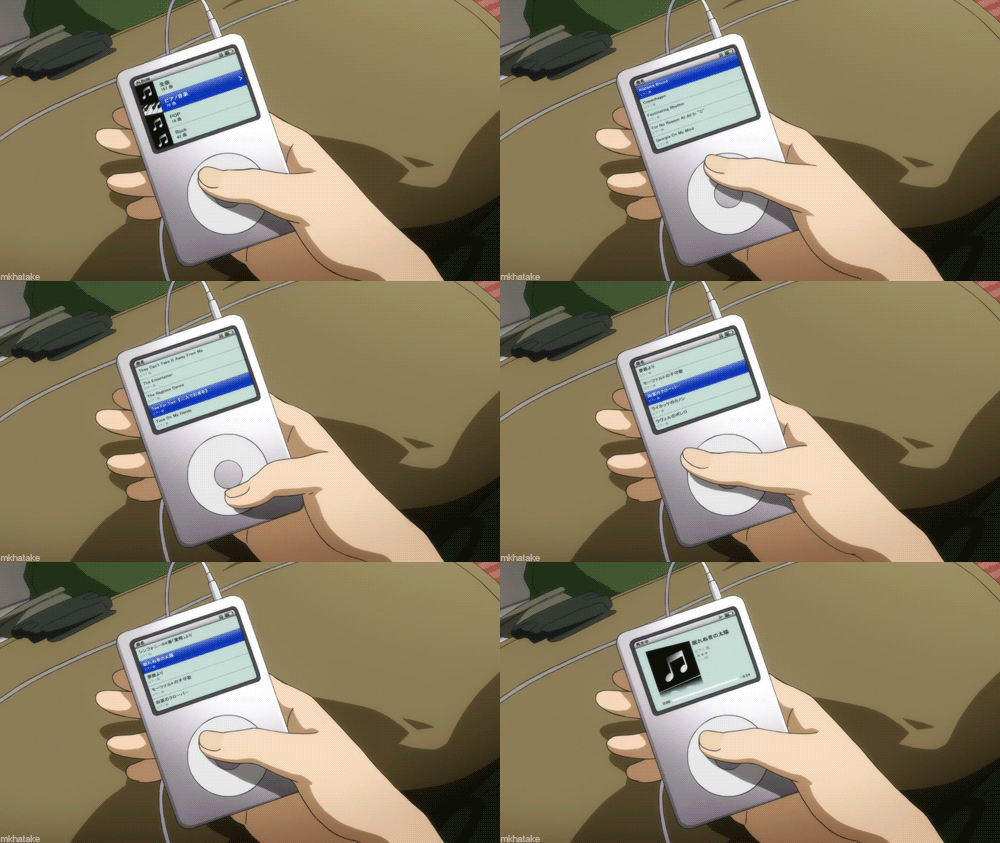
Connectivity-
Originally, a FireWire connection to the host computer was used to update songs or recharge the battery. The battery could also be charged with a power adapter that was included with the first four generations.
The third generation began including a 30-pin dock connector, allowing for FireWire or USB connectivity. This provided better compatibility with non-Apple machines, as most of them did not have FireWire ports at the time. Eventually Apple began shipping iPods with USB cables instead of FireWire, although the latter was available separately. As of the first-generation iPod Nano and the fifth-generation iPod Classic, Apple discontinued using FireWire for data transfer (while still allowing for use of FireWire to charge the device) in an attempt to reduce cost and form factor. As of the second-generation iPod Touch and the fourth-generation iPod Nano, FireWire charging ability has been removed. The second-, third-, and fourth-generation iPod Shuffle uses a single 3.5 mm minijack phone connector which acts as both a headphone jack and a data port for the dock.
The dock connector also allowed the iPod to connect to accessories, which often supplement the iPod's music, video, and photo playback. Apple sells a few accessories, such as the now-discontinued iPod Hi-Fi, but most are manufactured by third parties such as Belkin and Griffin. Some peripherals use their own interface, while others use the iPod's own screen. Because the dock connector is a proprietary interface, the implementation of the interface requires paying royalties to Apple.
Apple introduced a new 8-pin dock connector, named Lightning, on September 12, 2012 with their announcement of theiPhone 5, the fifth generation iPod Touch, and the seventh generation iPod Nano, which all feature it. The new connector replaces the older 30-pin dock connector used by older iPods, iPhones, and iPads. Apple Lightning cables have pins on both sides of the plug so it can be inserted with either side facing up.

Accessories-
Many accessories have been made for the iPod line. A large number are made by third party companies, although many, such as the iPod Hi-Fi, are made by Apple. Some accessories add extra features that other music players have, such as sound recorders, FM radio tuners, wired remote controls, and audio/visual cables for TV connections. Other accessories offer unique features like the Nike+iPod pedometer and the iPod Camera Connector. Other notable accessories include external speakers, wireless remote controls, protective case, screen films, and wireless earphones. Among the first accessory manufacturers were Griffin Technology,Belkin, JBL, Bose, Monster Cable, and SendStation. BMW released the first iPod automobile interface, allowing drivers of newer BMW vehicles to control an iPod using either the built-in steering wheel controls or the radio head-unit buttons. Apple announced in 2005 that similar systems would be available for other vehicle brands, including Mercedes-Benz, Volvo, Nissan,Toyota, Alfa Romeo, Ferrari, Acura, Audi, Honda, Renault, Infinit andVolkswagen. Scion offers standard iPod connectivity on all their cars.
Some independent stereo manufacturers including JVC, Pioneer, Kenwood, Alpine,Sony, and Harman Kardon also have iPod-specific integration solutions. Alternative connection methods include adapter kits (that use the cassette deck or the CD changer port), audio input jacks, and FM transmitters such as the iTrip—although personal FM transmitters are illegal in some countries. Many car manufacturers have added audio input jacks as standard.
Beginning in mid-2007, four major airlines, United, Continental, Delta, and Emirates, reached agreements to install iPod seat connections. The free service will allow passengers to power and charge an iPod, and view video and music libraries on individual seat-back displays. Originally KLM and Air France were reported to be part of the deal with Apple, but they later released statements explaining that they were only contemplating the possibility of incorporating such systems.

Software-
The iPod line can play several audio file formats including MP3, AAC/M4A, Protected AAC, AIFF, WAV, Audible audiobook, and Apple Lossless. The iPod photo introduced the ability to display JPEG, BMP, GIF, TIFF, and PNG image file formats. Fifth and sixth generation iPod Classics, as well as third generation iPod Nanos, can additionally play MPEG-4(H.264/MPEG-4 AVC) and QuickTime video formats, with restrictions on video dimensions, encoding techniques and data-rates. Originally, iPod software only worked with Mac OS; iPod software for Microsoft Windows was launched with the second generation model. Unlike most other media players, Apple does not support Microsoft's WMA audio format—but a converter for WMA files without Digital Rights Management (DRM) is provided with the Windows version of iTunes. MIDI files also cannot be played, but can be converted to audio files using the "Advanced" menu in iTunes. Alternative open-source audio formats, such as Ogg Vorbis and FLAC are not supported without installing custom firmware onto an iPod (e.g.,Rockbox).
During installation, an iPod is associated with one host computer. Each time an iPod connects to its host computer, iTunes can synchronize entire music libraries or music playlists either automatically or manually. Song ratings can be set on an iPod and synchronized later to the iTunes library, and vice versa. A user can access, play, and add music on a second computer if an iPod is set to manual and not automatic sync, but anything added or edited will be reversed upon connecting and syncing with the main computer and its library. If a user wishes to automatically sync music with another computer, an iPod's library will be entirely wiped and replaced with the other computer's library.

i Tunes Store-
iPods with color displays use anti-aliased graphics and text, with sliding animations. All iPods (except the 3rd-generation iPod Shuffle, the 6th & 7th generation iPod Nano, and iPod Touch) have five buttons and the later generations have the buttons integrated into the click wheel – an innovation that gives an uncluttered, minimalist interface. The buttons perform basic functions such as menu, play, pause, next track, and previous track. Other operations, such as scrolling through menu items and controlling the volume, are performed by using the click wheel in a rotational manner. The 3rd-generation iPod Shuffle does not have any controls on the actual player; instead it has a small control on the earphone cable, with volume-up and -down buttons and a single button for play and pause, next track, etc. The iPod Touch has no click-wheel; instead it uses a 3.5" touch screen along with a home button, sleep/wake button and (on the second and third generations of the iPod Touch) volume-up and -down buttons. The user interface for the iPod Touch is identical to that of the iPhone. Differences include a lack of a phone application. Both devices use iOS.
The iTunes Store (introduced April 29, 2003) is an online media store run by Apple and accessed through iTunes. The store became the market leader soon after its launch and Apple announced the sale of videos through the store on October 12, 2005. Full-length movies became available on September 12, 2006.
At the time the store was introduced, purchased audio files used the AAC format with added encryption, based on theFairPlay DRM system. Up to five authorized computers and an unlimited number of iPods could play the files. Burning the files with iTunes as an audio CD, then re-importing would create music files without the DRM. The DRM could also be removed using third-party software. However, in a deal with Apple, EMI began selling DRM-free, higher-quality songs on the iTunes Stores, in a category called "iTunes Plus." While individual songs were made available at a cost of US$1.29, 30¢ more than the cost of a regular DRM song, entire albums were available for the same price, US$9.99, as DRM encoded albums. On October 17, 2007, Apple lowered the cost of individual iTunes Plus songs to US$0.99 per song, the same as DRM encoded tracks. On January 6, 2009, Apple announced that DRM has been removed from 80% of the music catalog, and that it would be removed from all music by April 2009.
iPods cannot play music files from competing music stores that use rival-DRM technologies like Microsoft's protected WMA or RealNetworks' Helix DRM. Example stores include Napster and MSN Music. RealNetworks claims that Apple is creating problems for itself by using FairPlay to lock users into using the iTunes Store. Steve Jobs stated that Apple makes little profit from song sales, although Apple uses the store to promote iPod sales. However, iPods can also play music files from online stores that do not use DRM, such as eMusic or Amie Street.
Universal Music Group decided not to renew their contract with the iTunes Store on July 3, 2007. Universal will now supply iTunes in an 'at will' capacity.
Apple debuted the iTunes Wi-Fi Music Store on September 5, 2007, in its Media Event entitled "The Beat Goes On...". This service allows users to access the Music Store from either an iPhone or an iPod Touch and download songs directly to the device that can be synced to the user's iTunes Library over a WiFi connection, or, in the case of an iPhone, the telephone network.

Games-
Video games are playable on various versions of iPods. The original iPod had the game Brick (originally invented by Apple's co-founder Steve Wozniak) included as an easter egg hidden feature; later firmware versions added it as a menu option. Later revisions of the iPod added three more games: Parachute, Solitaire, and Music Quiz.
In September 2006, the iTunes Store began to offer additional games for purchase with the launch of iTunes 7, compatible with the fifth generation iPod with iPod software 1.2 or later. Those games were: Bejeweled, Cubis 2, Mahjong, Mini Golf,Pac-Man, Tetris, Texas Hold 'Em, Vortex, Asphalt 4: Elite Racing and Zuma. Additional games have since been added. These games work on the 6th and 5th generation iPod Classic and the 5th and 4th generation iPod Nano.
With third parties like Namco, Square Enix, Electronic Arts, Sega, and Hudson Soft all making games for the iPod, Apple's MP3 player has taken steps towards entering the video game handheld console market. Even video game magazines like GamePro and EGM have reviewed and rated most of their games as of late.
The games are in the form of .ipg files, which are actually .zip archives in disguise. When unzipped, they reveal executable files along with common audio and image files, leading to the possibility of third party games. Apple has not publicly released a software development kit (SDK) for iPod-specific development. Apps produced with the iPhone SDK are compatible only with the iOS on the iPod Touch and iPhone, which cannot run clickwheel-based games.

File storage and transfer-
All iPods except for the iPod Touch can function in "disk mode" as mass storage devices to store data files but this may not be the default behavior, and in the case of the iPod Touch, requires special software. If an iPod is formatted on a Mac OS computer, it uses the HFS+ file system format, which allows it to serve as a boot disk for a Mac computer. If it is formatted on Windows, the FAT32 format is used. With the release of the Windows-compatible iPod, the default file system used on the iPod line switched from HFS+ to FAT32, although it can be reformatted to either file system (excluding the iPod Shuffle which is strictly FAT32). Generally, if a new iPod (excluding the iPod Shuffle) is initially plugged into a computer running Windows, it will be formatted with FAT32, and if initially plugged into a Mac running Mac OS it will be formatted with HFS+.
Unlike many other MP3 players, simply copying audio or video files to the drive with a typical file management application will not allow an iPod to properly access them. The user must use software that has been specifically designed to transfer media files to iPods, so that the files are playable and viewable. Usually iTunes is used to transfer media to an iPod, though several alternative third-party applications are available on a number of different platforms.
iTunes 7 and above can transfer purchased media of the iTunes Store from an iPod to a computer, provided that computer containing the DRM protected media is authorized to play it.
Media files are stored on an iPod in a hidden folder, along with a proprietary database file. The hidden content can be accessed on the host operating system by enabling hidden files to be shown. The media files can then be recovered manually by copying the files or folders off the iPod. Many third-party applications also allow easy copying of media files off of an iPod.

Industry impact-
iPods have won several awards ranging from engineering excellence, to most innovative audio product, to fourth best computer product of 2006. iPods often receive favorable reviews; scoring on looks, clean design, and ease of use. PC World says that iPod line has "altered the landscape for portable audio players". Several industries are modifying their products to work better with both the iPod line and the AAC audio format. Examples include CD copy-protection schemes, and mobile phones, such as phones from Sony Ericsson and Nokia, which play AAC files rather than WMA.
Besides earning a reputation as a respected entertainment device, the iPod has also been accepted as a business device. Government departments, major institutions and international organisations have turned to the iPod line as a delivery mechanism for business communication and training, such as the Royal and Western Infirmaries in Glasgow, Scotland, where iPods are used to train new staff.
iPods have also gained popularity for use in education. Apple offers more information on educational uses for iPods on their website, including a collection of lesson plans. There has also been academic research done in this area in nursing education and more general K-16 education. Duke University provided iPods to all incoming freshmen in the fall of 2004, and the iPod program continues today with modifications. Entertainment Weekly put it on its end-of-the-decade, "best-of" list, saying, "Yes, children, there really was a time when we roamed the earth without thousands of our favorite jams tucked comfortably into our hip pockets. Weird."
The iPod has also been credited with accelerating shifts within the music industry. The iPod's popularization of digital music storage allows users to abandon listening to entire albums and instead be able to choose specific singles which hastened the end of the Album Era in popular music.
The advertised battery life on most models is different from the real-world achievable life. For example, the fifth generation 30 GB iPod is advertised as having up to 14 hours of music playback. An MP3.com report stated that this was virtually unachievable under real-life usage conditions, with a writer for MP3.com getting on average less than 8 hours from an iPod. In 2003, class action lawsuits were brought against Apple complaining that the battery charges lasted for shorter lengths of time than stated and that the battery degraded over time. The lawsuits were settled by offering individuals either US$50 store credit or a free battery replacement.
iPod batteries are not designed to be removed or replaced by the user, although some users have been able to open the case themselves, usually following instructions from third-party vendors of iPod replacement batteries. Compounding the problem, Apple initially would not replace worn-out batteries. The official policy was that the customer should buy a refurbished replacement iPod, at a cost almost equivalent to a brand new one. All lithium-ion batteries lose capacity during their lifetime even when not in use (guidelines are available for prolonging life-span) and this situation led to a market for third-party battery replacement kits.
Apple announced a battery replacement program on November 14, 2003, a week before a high publicity stunt and website by the Neistat Brothers. The initial cost was US$99, and it was lowered to US$59 in 2005. One week later, Apple offered an extended iPod warranty for US$59. For the iPod Nano, soldering tools are needed because the battery is soldered onto the main board. Fifth generation iPods have their battery attached to the backplate with adhesive.
The first generation iPod Nano may overheat and pose a health and safety risk. Affected iPod Nanos were sold between September 2005 and December 2006. This is due to a flawed battery used by Apple from a single battery manufacturer.Apple recommended that owners of affected iPod Nanos stop using them. Under an Apple product replacement program, affected Nanos were replaced with current generation Nanos free of charge.
iPods have been criticized for alleged short life-span and fragile hard drives. A 2005 survey conducted on the MacInTouch website found that the iPod line had an average failure rate of 13.7% (although they note that comments from respondents indicate that "the true iPod failure rate may be lower than it appears"). It concluded that some models were more durable than others. In particular, failure rates for iPods employing hard drives was usually above 20% while those with flash memory had a failure rate below 10%. In late 2005, many users complained that the surface of the first generation iPod Nano can become scratched easily, rendering the screen unusable. A class action lawsuit was also filed. Apple initially considered the issue a minor defect, but later began shipping these iPods with protective sleeves.